← All projects

Maxfibre Broadband

Maximum broadband speeds with maximum savings. A data-driven redesign that delivered +30% conversions, −25% drop-off rate, and 80% mobile orders.

Role

Lead UI/UX Designer & UX Researcher

Tools

Figma · Google Analytics · Hotjar

Outcome

+30% conversions · −25% drop-off · −20% checkout time

Maxfibre Broadband

Overview

The challenge

Maxfibre's existing website had high drop-off during the checkout process and poor mobile performance despite significant mobile traffic. The redesign needed to simplify the sign-up journey, clarify the pricing tiers, and make the experience genuinely faster on mobile.

Project goals

  • Increase conversion rate through a simpler checkout flow
  • Reduce drop-off by making pricing and plan differences clearer
  • Optimise for mobile — where the majority of orders were placed
  • Reduce time-to-complete-checkout by at least 15%
+30%
Conversion rate increase
−25%
Drop-off rate reduction
−20%
Checkout time reduction
80%
Orders placed on mobile

UX Research

Diagnosing the problem

Using Hotjar heatmaps and Google Analytics funnels, I identified where users were dropping off and why. Session recordings revealed confusion at the plan-selection and postcode-verification steps.

Drop-off points

  • Plan comparison page — users couldn't distinguish between tiers
  • Postcode check — too many steps before confirming availability
  • Checkout — form fields caused abandonment on mobile

User expectations

  • Clear speed and price comparison upfront
  • Instant postcode availability check
  • Mobile-friendly form inputs with minimal typing

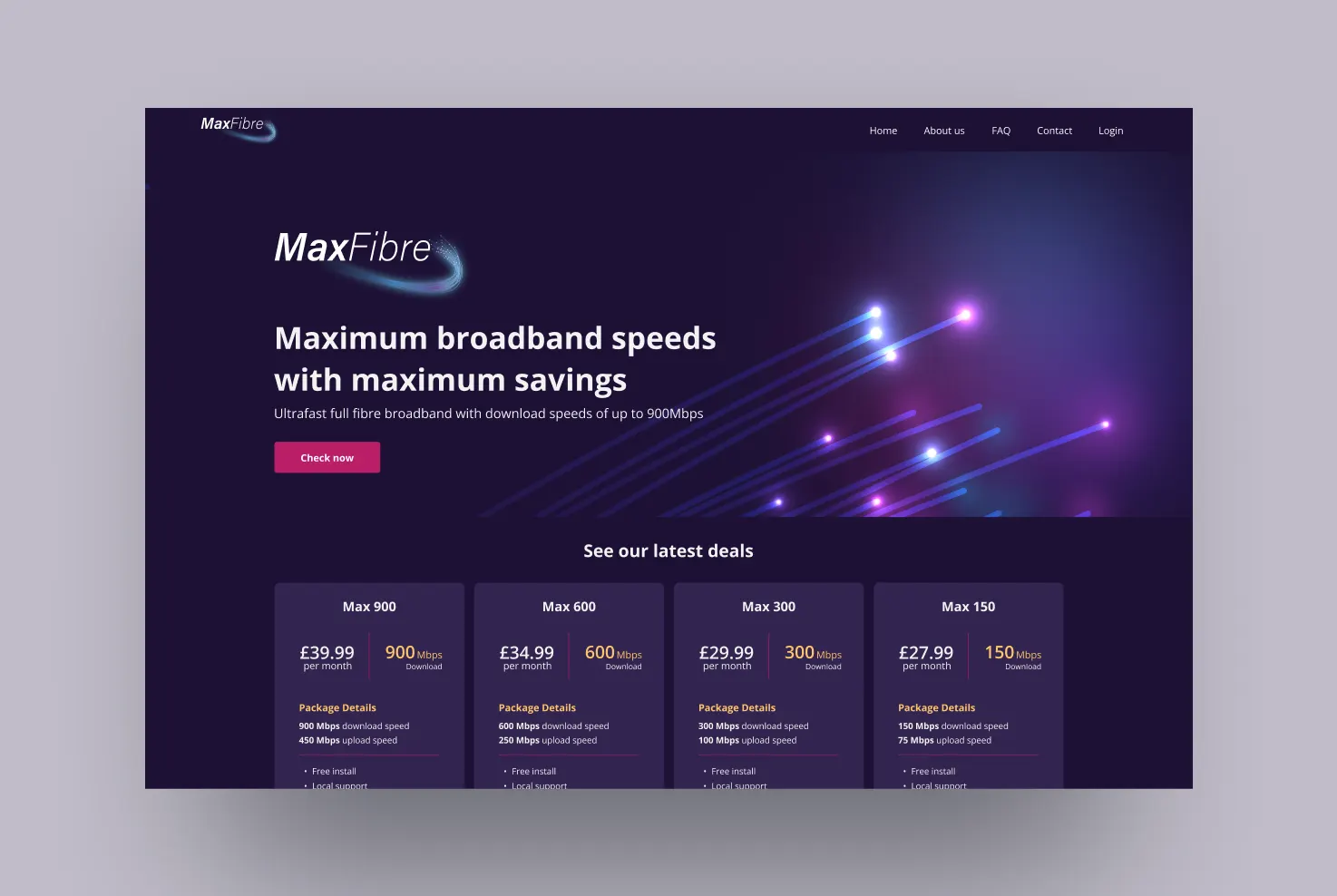
Pricing tiers defined

MAX 900

Top-tier plan for power users and households

MAX 600

High-speed plan for streaming-heavy homes

MAX 300

Mid-range plan for everyday browsing

MAX 150

Entry-level plan for light users

Competitive Analysis

Market benchmarking

I benchmarked Maxfibre against four major UK broadband providers to understand best practices in plan comparison, checkout UX, and mobile optimisation.

Sky

Strong brand trust; plan comparison table hard to scan on mobile

Virgin Media

Fast checkout; confusing bundle upsells created friction

BT

Comprehensive plans; too many steps before seeing pricing

Hyperoptic

Clean design; postcode check well-integrated but plan cards lacked clarity

Opportunity: No competitor combined instant postcode checking with a truly clean, mobile-native plan comparison in a single step.

UX Design Process

Information architecture & order flow

To create a seamless broadband sign-up experience, the order journey was carefully structured to reduce drop-offs and increase efficiency. Each section was designed to minimise user effort while maintaining full transparency.
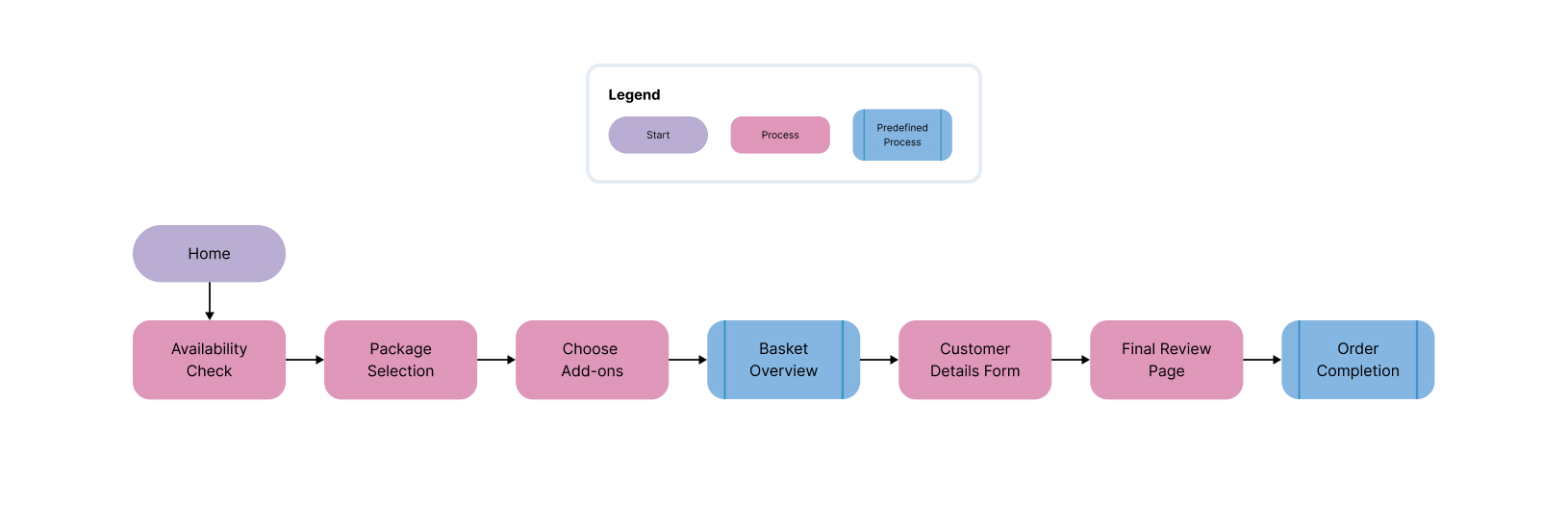
Maxfibre order flow architecture

Order flow breakdown

  • Availability Check: Users enter postcode first — confirming availability before investing in the process
  • Package Selection: Plan cards highlighting speed, cost, contract terms, and use-case badges like "Best for Streaming"
  • Basket Overview: Review and modify selections with optional add-ons before committing
  • Customer Details Form: Auto-fill suggestions, inline validation, reduced fields
  • Final Review + Order Completion: Full summary with confirmation email trigger

Key design decisions

  • Progress bar on every step — users always know how many steps remain
  • Plan cards redesigned as horizontal comparisons on mobile, reducing scroll depth
  • Checkout consolidated from 6 steps to 3 with smart defaults
  • Live order modification — users can navigate back without losing entered data

A custom WCAG 2.0 compliant customer dashboard was also designed — contact for access to the full interactive prototype.

Testing

A/B testing & iteration

A/B tests were run via postcode segments, allowing us to test plan card layouts, CTA copy, and checkout flows against distinct user groups without cross-contamination.

Test 1 — Plan cards

  • Horizontal swipe cards outperformed vertical stacked list by 18% in plan selection rate

Test 2 — CTA copy

  • "Check availability" outperformed "Get started" by 12% in click-through to postcode step

Results

Outcome

+30%
Conversion rate increase
−25%
Drop-off rate reduction
−20%
Checkout time reduction
80%
Orders completed on mobile

The redesigned order journey delivered across every metric that mattered. A 30% lift in conversions, 25% fewer abandoned checkouts, and a 20% faster path to completion — achieved by removing confusion at the exact points the data told us users were leaving.

The mobile result was the most telling: 80% of completed orders came from mobile devices. That validated the mobile-first approach entirely and confirmed that previous drop-off wasn't user reluctance — it was friction the design had introduced.

Key takeaways

  • Data made the case. Hotjar heatmaps and GA funnels told us exactly where users were leaving. That precision meant we fixed the right things, not just the obvious ones.
  • A/B testing on postcodes was the right call. Testing plan card layouts and CTA copy across geographic segments avoided contamination and gave clean, actionable results.
  • Small UX changes, large business impact. A progress bar and a basket system — modest additions — were directly responsible for the biggest conversion improvement. Complexity wasn't the answer; clarity was.